
Remuneration policy guidelines
The goal of the remuneration policy applied across LTG Group is to support long-term, employee-focused decisions that help implement the Group’s strategic directions:
• Offer a competitive compensation package to attract and retain employees with the required competencies;
• Ensure equal opportunities and non-discrimination when evaluating employee performance and awarding compensation;
• Uphold the principle of internal fairness by providing equal pay for similar work;
• Increase employee engagement;
• Encourage professional development and skills enhancement;
• Promote transparency and responsible governance;
• Contribute to efficient personnel cost management and create value for shareholders.
Implementation Principles
To achieve these goals, LTG Group has developed a comprehensive position map and established uniform remuneration review principles, which include:
• Job evaluation based on internationally recognized methodologies;
• Internal salary data comparison with market benchmarks;
• Annual performance reviews involving all company employees.
These steps ensure transparency in decisions related to compensation and its adjustments, while reinforcing a remuneration system that is clearly understood by all employees and linked to individual performance.
All components of remuneration, principles of remuneration management, and the decision-making matrix applied within the LTG Group are outlined in the Remuneration Policy.
The Chief Executive Officer’s salary consists of a base salary defined in the employment contract and a performance-based incentive. This incentive is linked to:
• Achievement of LTG Group’s annual goals approved by the Board (60%)
• Achievement of the Company’s annual goals (30%)
• Leadership performance and personal objectives (10%)
Each year, the Board approves the structure of annual goals, threshold values for achievement, and comparative weightings. After the year ends, the Board confirms the results and determines the size of the performance-based incentive. The maximum incentive may not exceed 30% of the annual base salary.
Remuneration principles within the company are transparent and applied equally to all employees, regardless of gender or other aspects of individual identity.
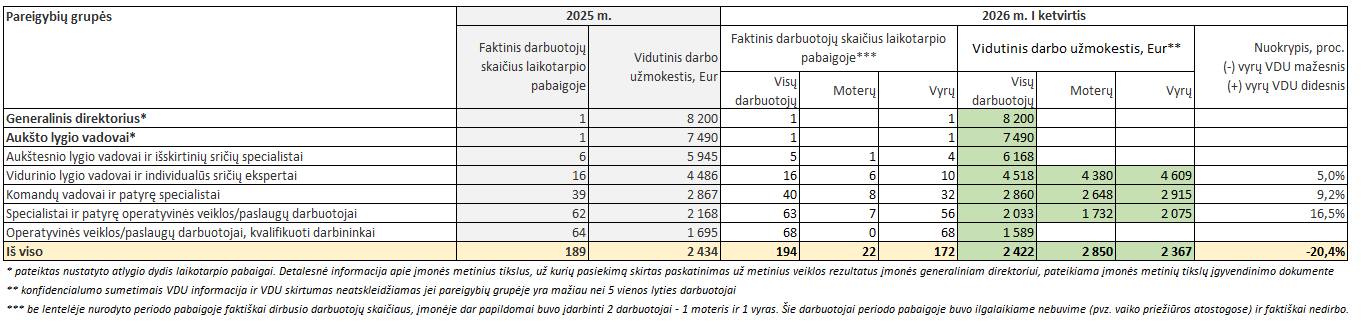
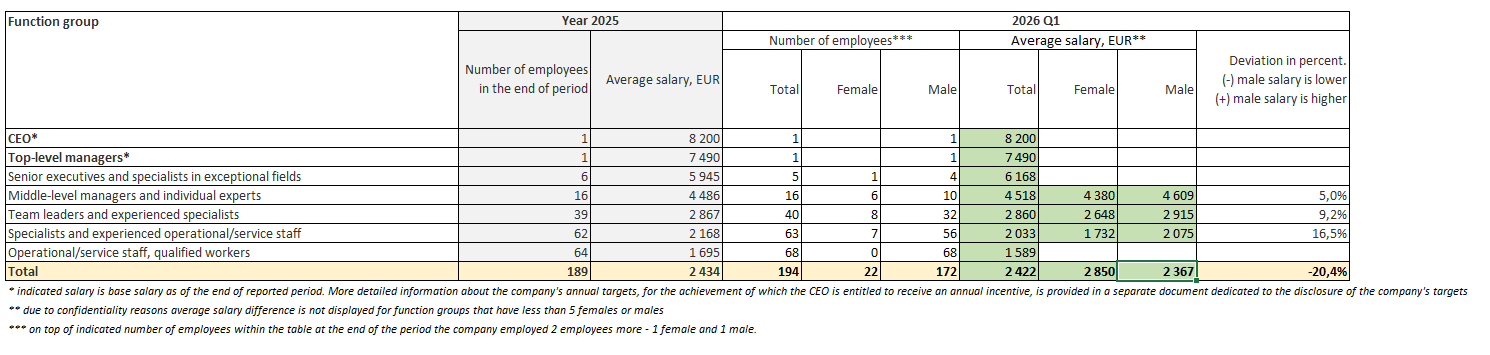
Data on the number of employees and average salary is published publicly, regardless of gender and other aspects of individual identity. Additionally, the average salary for men and women is calculated and compared separately.
More information about remuneration
Lygių galimybių ir įvairovės LTG užtikrinimo priemonės rasite čia
The number of employees and average salary
When disclosing data on the number of employees and average salary, the company also provides a breakdown of average salaries for men and women across different job categories, along with a comparison of these figures.
The principles for determining remuneration within the company are transparent and uniformly applied to all employees, regardless of gender or other aspects of individual identity.
The largest actual differences in average salary between men and women are primarily due to occupational distribution. More men than women are employed not only in the railway industry overall, but also across many job categories — especially in operational roles. Women tend to dominate in supporting and administrative functions, which generally have lower market salary levels. Men are concentrated in roles that command higher market compensation, often involving specialized tasks, physical labor, outdoor work, or challenging conditions, where market pay levels are higher.
UAB Geležinkelio tiesimo centras 2025/2026 I ketvirčio darbo užmokestis
UAB Geležinkelio tiesimo centras average salary 2025/2026 Q1
 English (UK)
  Lietuvių kalba